What Causes Postpartum Depression (PPD)? Why It Happens and What Raises the Risk

Written by
Expert health information, double-checked for accuracy and written to be helpful.
Last updated
Written by
Expert health information, double-checked for accuracy and written to be helpful.
Last updated
If you're asking why this is happening to you, especially when you're doing your absolute best, you deserve a straight answer. Here is what causes postpartum depression (PPD), what raises the risk, and what you can do with that knowledge.
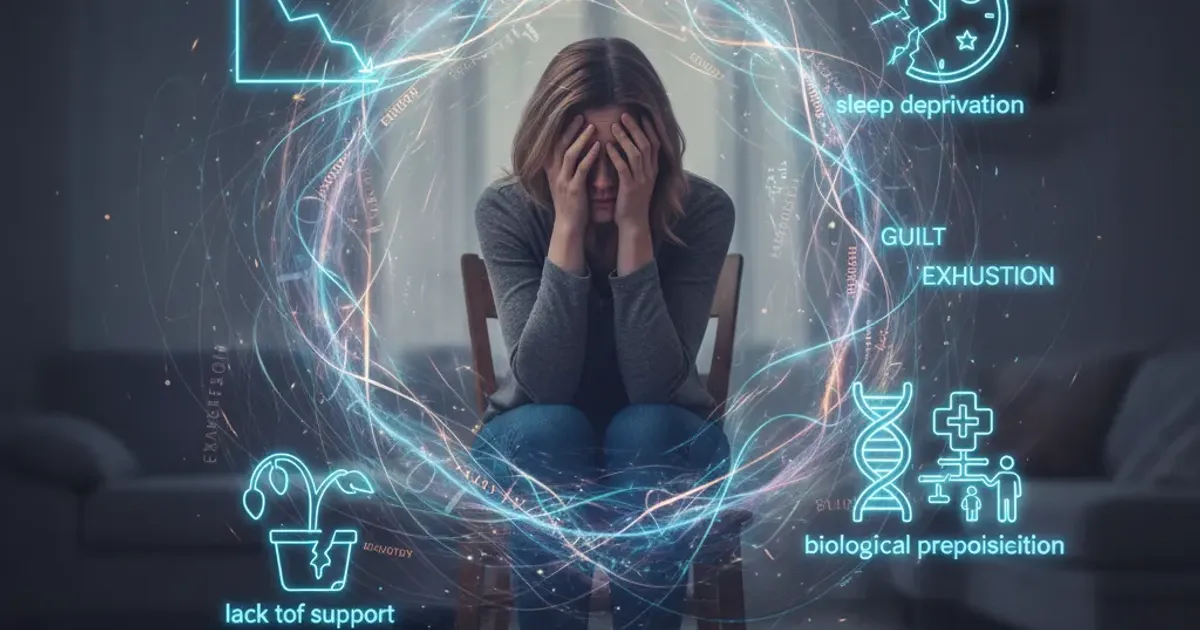
Postpartum depression (PPD) has no single cause. It comes from a mix of biology (a big hormone shift and a brain that may be more sensitive to it), sleep loss, personal history and life circumstances. It is not caused by anything you did or did not do. About 1 in 8 US mothers report symptoms a few months after birth.
Key Takeaways
- PPD usually builds from several causes at once: something you bring in, something that sets it off, and something that keeps it going.
- Every new mother has a steep hormone drop. The difference between people seems to be how sensitive the brain is to it.
- Even the strongest risk factors don't make PPD certain, and some people get PPD with none.
- PPD is not your fault, and it is treatable. A short screening questionnaire is a simple first step.
What Causes Postpartum Depression? Usually a Pile-Up, Not One Thing
Two parents can have similar births and similar babies, and only one develops PPD. It makes more sense once you know that PPD does not have a single cause, as the National Institute of Mental Health (NIMH) puts it.
A helpful way to picture it is in three parts:
- What you bring in: a past episode of depression or anxiety, depression during this pregnancy, a family history of depression, or a hard childhood.
- What can set it off: the hormone drop after birth, a frightening birth, a NICU stay, severe sleep loss or a big life stress.
- What keeps it going: feeling unsupported, conflict at home, loneliness and money strain.
Having a risk factor does not mean you will get PPD. And some people get it with no obvious risk factor at all.
It's common for parents to start therapy with a one-cause story: it's my hormones, or I'm just weak. Much of the early work is widening that story to the full mix, which also shows which parts are within reach.
| What you bring in | What can set it off | What keeps it going |
|---|---|---|
| Depression or anxiety before or during pregnancy | The steep hormone drop after birth, for people sensitive to it | Feeling unsupported by a partner or others |
| A past episode of depression | An emergency cesarean or a frightening birth | Conflict, emotional abuse or violence at home |
| A family history of depression or bipolar disorder | A preterm birth or a NICU stay | Loneliness |
| A hard childhood | Severe sleep loss in late pregnancy or the early weeks | Money strain |
| An unplanned pregnancy | A big life stress | Poor sleep that keeps going |
When you catch yourself hunting for the one thing that caused this, try sorting what you know into these three columns instead.
The Postpartum Hormone Plunge, and Why It Isn't the Whole Story
Estrogen and progesterone drop sharply after birth for every new mother. Yet most do not develop PPD.
Studies have not found that mothers with PPD have different hormone levels, or a faster drop. The leading idea is sensitivity: some brains react more strongly to the same change.
Hormones are part of the picture for some people. But calling PPD "just hormones" or "a chemical imbalance" oversimplifies it.
Thyroid levels can drop after birth, and low thyroid can cause symptoms of depression, according to the Office on Women's Health. A simple blood test can check. Breastfeeding hormones are being studied, but they are not an established cause. Low vitamin D and anemia show only weak links in some studies.
| Myth | Fact |
|---|---|
| PPD is just hormones, or a chemical imbalance. | Every new mother has the hormone drop, and most do not get PPD. The difference seems to be how sensitive the brain is to the change, and sleep, history and circumstances matter too. |
| If I were stronger, I would not have PPD. | PPD is not caused by anything a parent did or did not do. |
| Formula feeding causes PPD. | The link between feeding trouble and PPD runs both ways, and it does not mean formula feeding causes PPD. |
| Only people with risk factors get PPD. | Some people get PPD with no obvious risk factor at all. |
When someone says it's "just hormones," try remembering that hormones are only one piece.
Sleep Deprivation: How Much It Matters
If you feel so drained you can't keep up, sleep may be a bigger part of this than it looks.
Reviews of many studies link poor sleep in late pregnancy and the early weeks after birth to higher rates of PPD. It likely works both ways. Poor sleep can feed low mood, and depression can make sleep worse even when the baby is asleep.
In a review of trials for a 2025 Canadian guideline, sleep programs led to a small drop in symptoms. They did not lower the chance of developing depression. Read more about how sleep loss and PPD feed each other.
Try the "one longer stretch" plan
Sharing night care has not been tested on its own in trials, so treat it as a way to protect sleep, not a treatment.
- Pick a block of about four to five hours, even just a few nights a week.
- Hand the baby to a partner, relative or friend for that block. If feeding allows, they use a bottle or pumped milk.
- Use earplugs and put your phone in another room.
- Keep the baby's sleep safe. The baby sleeps in their own crib or bassinet, or is held by an adult who is seated and awake. Never lie down or recline with the baby on you. Couches and armchairs are never safe places for a baby to sleep. Ask your pediatrician any questions about how your baby should sleep.
When nights start to blur together, try naming one protected block this week and who covers the baby.
Risk Factors for Postpartum Depression: What Raises the Chance
Large reviews of the research agree on a short list of the strongest risk factors:
- Depression or anxiety during pregnancy
- A past history of depression
- Violence or emotional abuse, especially from a partner
- Poor support from a partner or others
- Major life stress or an unplanned pregnancy
Most of these raise the odds about two to three times. Depression during pregnancy stands out. In one large review of 88 studies, it raised the odds roughly four times. More than 1 in 3 women who were depressed in pregnancy went on to have PPD. Even so, having any of these does not mean you will get PPD.
Personal and Family History of Mental Health Conditions
A past episode of depression or anxiety is the clearest warning sign. PPD also runs in families to a degree. Twin and family studies suggest genes explain roughly a third to a half of the differences between people. The rest comes from life and experience. That figure describes groups, not your own risk. No genetic or blood test can predict PPD. If you or a close relative has bipolar disorder, tell your clinician before birth or soon after.
Support, Relationship Strain and Financial Worries
Feeling unsupported, a conflict-filled relationship, and especially violence or emotional abuse from a partner roughly double to triple the odds. In a CDC survey, about 1 in 3 women who reported partner violence had PPD symptoms. For women who did not, it was about 1 in 8.
Money strain counts too. In a global review, about 1 in 3 mothers with financial problems had PPD, compared with about 1 in 6 without. Loneliness also comes up again and again in mothers' own accounts of PPD. If it feels like no one understands, that belongs in the picture too.
When you see yourself in this list, try treating it as information to bring to your clinician, not as a prediction.
A Traumatic Birth, a NICU Stay or a Hard Start
A hard start can add to the load. An emergency cesarean, a frightening or traumatic birth, a preterm birth or NICU stay, a baby with health problems or a lot of crying, and trouble with feeding are all linked to higher rates of PPD.
These links are real. But they are generally smaller or less certain than the links with past depression, support and stress. One review of 18 studies found that a planned cesarean, on its own, did not appear to raise the risk.
The feeding link runs both ways, and it does not mean formula feeding causes PPD. None of this means you caused your PPD by how the birth went.
When the birth or the NICU weeks keep replaying in your mind, try telling your clinician about them directly.
Why PPD Can Start Months Later, or With a Second Baby
PPD does not always start in the first weeks. A large US study followed nearly 5,000 New York mothers for three years. About 1 in 12 had symptoms that started low and rose over time. About 1 in 4 had high symptoms at some point. Many cases also begin in pregnancy. If you feel worse months later, read about PPD that shows up months after birth.
PPD can also happen with any baby, including after an easy first time. The evidence on birth order is mixed. The clearest pattern is a past episode. In one Danish study, about 1 in 5 women who had hospital care for PPD after a first birth had another episode after the next. Most did not.
The baby blues are different. Tearfulness and mood swings in the first days after birth usually fade within two weeks. If low mood lasts longer, or feels severe, raise it.
Partners get depressed too. A review of 47 studies found that roughly 9 in 100 fathers had depression during pregnancy or in the first year after birth. A separate review of 17 studies found risk factors that look like those for mothers, including a past mental health condition, job or money stress, and major life events.
When low mood shows up months in, or with a later baby, try raising it just as you would have in the first weeks.
It Is Not Your Fault
A parent a few months out might put it this way: the birth went fine, the baby is healthy, my partner helps, and I still feel nothing. Nothing went wrong, so it must be me.
NIMH answers that plainly. Perinatal depression (depression during pregnancy or after birth) is not caused by anything a mother has or has not done.
Feeling numb, detached or even regretful can be part of depression. Trouble bonding with your baby is on NIMH's own list of symptoms. These feelings are symptoms to treat. They do not prove you are a bad parent. You can love your baby and still feel flat.
When the thought "this is my fault" shows up, try answering it with what you now know: PPD has causes, and you did not choose them.
Can You Prevent Postpartum Depression? What You Can and Can't Change
You can't change your history, your genes or how the birth went. Several other things are within reach:
- Treatment for depression or anxiety during pregnancy
- Practical and emotional support, including from a partner
- Protecting at least some sleep
- Less isolation, such as time with other parents
- Help with money, food or safety problems through local services
For people at higher risk, counseling helps. The US Preventive Services Task Force (USPSTF) reviewed trials of counseling during pregnancy or after birth. Counseling lowered the chance of perinatal depression by about 40 percent. Most programs used cognitive behavioral therapy (CBT) or interpersonal therapy (IPT). If you have a history of depression or one of the strongest risk factors above, ask your OB or midwife about counseling now.
No supplement has been shown to prevent PPD.
When everything feels like too much to fix, try picking one item above and asking one person to help with it.
When to Get Help, and Who to Call
PPD is treatable. NIMH names cognitive behavioral therapy and interpersonal therapy as evidence-based therapies for it. Waiting has a cost, though. In the New York study, about 1 in 20 mothers had high symptoms at every check across three years. It is never too late to start.
If you're weighing medication, that's a conversation for your prescriber or OB.
You don't need every cause figured out first. A therapist who specializes in perinatal mental health can help you sort out your own mix. See how therapy for postpartum depression at Phoenix Health works.
What an evaluation looks like
Screening is a short questionnaire, not a diagnosis. The most common one is the Edinburgh Postnatal Depression Scale (EPDS). It asks 10 questions about the past seven days and takes about five minutes. A high score means a clinician should talk with you further. A low score does not rule depression out.
The American College of Obstetricians and Gynecologists and the USPSTF both recommend screening during pregnancy and after birth. The American Academy of Pediatrics adds screening at the baby's 1-, 2-, 4- and 6-month checkups. Still, about 1 in 5 mothers say they weren't asked about depression during prenatal visits, so raise it yourself. Mention past depression or anxiety, a family history of depression or bipolar disorder, a traumatic birth or a NICU stay. For help reading your result, see what a screening score means and what to do next.
Signs to act on today
Some signs mean you should get help the same day, not at your next appointment:
- Thoughts of harming yourself or your baby
- Being unable to care for yourself or your baby
- Feeling confused or out of touch with reality
- Seeing or hearing things others don't
- Not being able to sleep, even when the baby sleeps
If you're having thoughts of harming yourself or your baby, call or text 988 to reach the 988 Suicide and Crisis Lifeline, any time of day. If you feel confused or out of touch with reality, see or hear things others don't, or anyone is in immediate danger, call 911 or go to the nearest emergency room. For the other signs, call your OB, midwife or doctor today. If making the call feels like too much, ask your partner or someone you trust to call for you. For support when it isn't an emergency, the National Maternal Mental Health Hotline (1-833-852-6262) is free, confidential and open 24/7 by call or text. The Postpartum Support International HelpLine (1-800-944-4773) offers information, support and local resources, and volunteers return calls and texts. Neither one is a crisis line.
When you're unsure whether it's "bad enough" to mention, try raising it anyway at your next OB or pediatric visit.
Where to Start
You've done hard work here by asking why this is happening instead of only blaming yourself. Understanding the causes doesn't mean you have to sort them out alone. With a perinatal therapist, an evaluation usually covers how you feel now, your history and life at home, so the plan fits your mix. When you're ready, try one small step: reach out to the therapists at Phoenix Health, or raise it with your OB or your baby's pediatrician first.
Frequently Asked Questions
- Postpartum depression (PPD) has no single cause, according to the National Institute of Mental Health. It usually builds from a mix of factors. Some are things a parent brings in, like a past episode of depression or anxiety, depression during pregnancy, a family history of depression, or a hard childhood. Some can set it off, like the steep hormone drop after birth, a frightening birth, a NICU stay or severe sleep loss. Others keep it going, like low support, conflict at home, loneliness and money strain. The leading idea about hormones is that the difference between people lies in how sensitive the brain is to the change, not in the hormone levels themselves. Having a risk factor does not mean you will get PPD, and some people get it with no obvious risk factor at all. PPD is not caused by anything you did or did not do. It is treatable, and a short screening questionnaire with your OB, midwife or pediatrician is a good first step.
- Hormones are part of the picture, but not the whole explanation. Estrogen and progesterone drop sharply after every birth, yet most new mothers do not develop postpartum depression. Studies have not found that mothers with PPD have different hormone levels or a faster drop. The leading idea is that some people's brains are more sensitive to the change. Thyroid levels can also drop after birth, and low thyroid can cause symptoms of depression, so ask your clinician about a simple blood test. Breastfeeding hormones are being studied but are not an established cause. Because PPD also depends on sleep, history, support and stress, calling it "just hormones" or "a chemical imbalance" oversimplifies it.
- A hard birth can add to the load, but it is usually one piece among several. An emergency cesarean, a birth that felt frightening or traumatic, a preterm birth, a NICU stay and trouble with feeding are all linked to higher rates of postpartum depression. These links are real but generally smaller or less certain than the links with past depression, low support and major life stress. One review of 18 studies found that a planned cesarean, on its own, did not appear to raise the risk. A frightening birth can also lead to posttraumatic stress. A 2022 review of 154 studies found that about 1 in 20 mothers developed posttraumatic stress disorder (PTSD) related to birth, and birth-related PTSD often shows up alongside depression. None of this means you caused your PPD by how the birth went. If your birth still replays in your mind, tell your OB, midwife or therapist. It is part of your history and worth sharing.
- A family history of depression does raise the chance of postpartum depression. The National Institute of Mental Health lists a personal or family history of depression or bipolar disorder among the risk factors. Twin and family studies suggest genes explain roughly a third to a half of the differences between people in who gets perinatal depression (depression during pregnancy or after birth). That figure describes groups, not your own odds. The rest comes from life and experience, such as sleep, support, stress and your own history. No single PPD gene has been found, and no genetic or blood test can predict or diagnose PPD. A family history is a reason to tell your clinician, not a prediction. Tell your OB, midwife or primary care clinician about your mother's experience, especially if anyone in your family has bipolar disorder. That lets them screen you during pregnancy and after birth, and plan support early.
- Yes. The National Institute of Mental Health describes perinatal depression as depression that occurs during pregnancy and after childbirth. In one study of women who screened positive four to six weeks after delivery, about 1 in 3 had episodes that began during pregnancy. Depression during pregnancy is also one of the strongest risk factors for depression after birth. In one large review of 88 studies, it raised the odds of postpartum depression roughly four times, and more than 1 in 3 women who were depressed in pregnancy went on to have it. That is why the American College of Obstetricians and Gynecologists recommends screening at the first prenatal visit and later in pregnancy, not only after birth. Even so, about 1 in 5 US mothers say they were not asked about depression during prenatal visits. It is fine to bring it up yourself. Depression in pregnancy is treatable, which makes it one of the risk factors within your reach.
- Not always, but the chance can be lowered, especially for people at higher risk. Some risk factors can't be changed, like your history, your genes or how the birth went. Others are within reach: treating depression or anxiety during pregnancy, building practical and emotional support, protecting some sleep, reducing isolation, and getting help with money, food or safety problems. The US Preventive Services Task Force reviewed trials of counseling for people at higher risk. Counseling during pregnancy or after birth, mostly cognitive behavioral therapy (CBT) or interpersonal therapy (IPT), lowered the chance of perinatal depression (depression during pregnancy or after birth) by about 40 percent. The Task Force recommends that clinicians offer this counseling or refer people at higher risk to it. Signs of higher risk include a history of depression, current mild symptoms, recent partner violence, high anxiety and major life stress. If any of these fit you, ask your OB or midwife about counseling now.
Ready to get support for Postpartum Depression?
Our PMH-C certified therapists specialize in Postpartum Depression and can typically see you within a week.
Not ready to book? Dr. Emily writes a short email series on Postpartum Depression, honest and practical, from a PMH-C therapist who's been through it herself.
No spam · Unsubscribe anytime