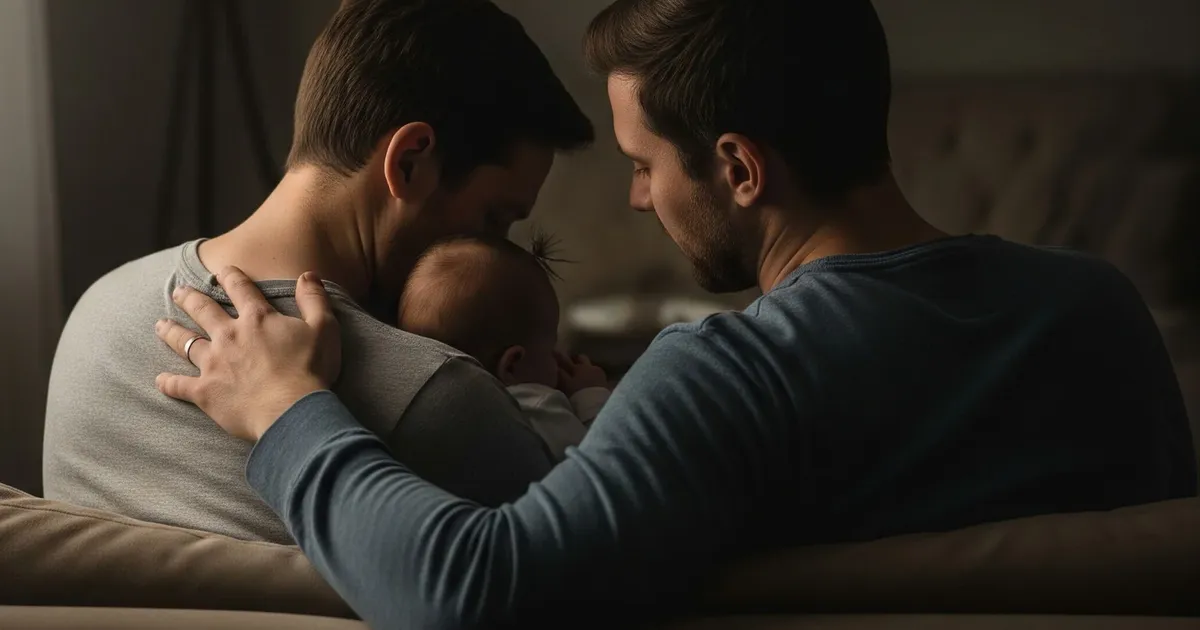
Postpartum Loneliness: Why You Feel Alone Even With a Partner, and What Helps

Written by
Expert health information, double-checked for accuracy and written to be helpful.
Last updated
Written by
Expert health information, double-checked for accuracy and written to be helpful.
Last updated
If you feel lonely with a baby in your arms and a partner in the next room, you are not alone in that, and you are not ungrateful.
Postpartum loneliness is common after a baby, and it has more than one cause. It can happen even when your partner is helping. Being close to one person is not the same as having people who share your season of life. It is also not the same as having a clear sense of who you are now.
Key Takeaways
- If you feel alone next to a partner who helps, try asking which kind of loneliness it is: closeness, a circle of people who get it, or a sense of who you are now.
- If you want your partner to understand, try one feeling plus one request: "I've been feeling really alone in the evenings. Could you take the 9 pm feed twice this week so I can call a friend?"
- If your support has thinned out since the first weeks, try putting one weekly chat with someone who gets it on the calendar.
- If loneliness or low mood has lasted more than two weeks, try bringing it to a clinician, such as your OB, your baby's pediatrician or a perinatal therapist.
What postpartum loneliness is, and how common it is
Maybe you have thought, "motherhood is isolating in a way I never expected." You are far from the only parent to feel that way.
Postpartum loneliness is the feeling of being cut off, unseen or unsupported since your baby arrived. It can happen whether or not people are around you. It is about how connected you feel, more than how many people are in the room.
Studies find that somewhere between a third and a half of new parents report feeling lonely, depending on how it is measured. One 2022 review found the numbers varied widely between studies. Each study used different groups of parents and different questions.
You can feel the happiest and most filled with love you have ever been, and so isolated at the same time. Both are true. Neither one cancels the other.
When you catch yourself thinking the loneliness means you are ungrateful, try reminding yourself that it is a common response to a huge change, not a verdict on your love for your baby.
Why you can feel alone with someone right there
You may have thought, "my partner is great and helps so much, and I'm still just so lonely." That thought often comes with guilt. One way of thinking about loneliness may ease it.
Loneliness researchers have long described more than one kind. The idea goes back to a researcher named Weiss, who split loneliness into two kinds: emotional and social. A 1984 study by Russell and colleagues supported that split.
Adding a third kind, about identity, is a lens we use, drawn from that research and from recent interviews with new mothers. No study has tested this three-kind idea in new parents.
Closeness loneliness is missing the feeling of being truly known by the person who matters most. A partner can meet this one, though not always. In a 2023 review of 27 studies where mothers with depression described their loneliness, feeling disconnected from a partner was itself a common source.
Circle loneliness is missing people in the same stage of life, someone who just gets it. A partner, however loving, cannot stand in for a whole circle.
"Who am I now" loneliness is feeling overlooked as a person, or unsure who you are since the baby. Mothers in a 2026 interview study described it as a disruption in their sense of self.
| Kind of loneliness | What it feels like | What meets it | What you might try |
|---|---|---|---|
| Closeness loneliness | Your partner is in the room, but you feel unseen or far apart | Feeling known by your partner or another close person | Tell your partner one true feeling and one specific request |
| Circle loneliness | Nobody around you is living what you are living, and you miss someone who just gets it | People in the same stage of life | One recurring chat or group with parents who understand this stage |
| "Who am I now" loneliness | You feel overlooked as a person, and your old self feels far away | Time and space to be yourself, not only a parent | A small weekly slot for something that is just yours |
This table is a lens for sorting your feelings, not a diagnosis.
If the distance from your partner is the biggest part of it, our guide to feeling distant from your partner after baby goes deeper.
When you feel lonely next to someone who loves you, try asking which kind it is today. The answer tells you whether to turn toward your partner, toward people who get it, or toward yourself.
Why it happens after a baby
Parents' own accounts of loneliness point mostly to how life has changed.
- The village drops away. Many parents describe lots of support in the first weeks. Then visitors return to their routines, and the early help fades.
- Your world gets smaller. Women in that 2023 review described "a sudden sense of emotional disconnection after birth."
- The support you got is not the support you expected. The same review found a gap between the support women expected and what partners, family and community gave.
- The load is uneven. In a 2019 US study of 393 mothers with partners, mothers who carried most of the planning of home life reported less satisfaction and more emptiness. Their children were of various ages.
- The childcare is uneven too. In a 2026 study in China, more than 9 in 10 new mothers made a high contribution to childcare, compared with about 4 in 10 fathers.
- Sleep loss travels with low mood. Studies link sleep problems in pregnancy to depression after birth, and depression often comes with loneliness. No study has shown that lost sleep causes loneliness.
- Hiding it makes it heavier. Women in that 2023 review hid how they felt for fear of being judged a "bad mother." That hiding deepened their loneliness.
When you notice the loneliness got worse after the visitors stopped or the early help faded, try treating it as a change in your support, not a flaw in you.
What happens to a relationship in the first year
Feeling far from your partner in the first year can be scary.
A 2022 review that pooled 49 studies found that, on average, satisfaction with the relationship dips after a first baby. The drop from pregnancy to the baby's first birthday was small to medium in size. A smaller dip followed in the second year.
Mothers and fathers felt the dip by similar amounts. When one partner's satisfaction dropped steeply, the other's tended to drop as well. Couples without children also became less satisfied over the same stretch of time, just less so.
So feeling farther apart this year is common. By itself, it does not mean your relationship is failing.
Your partner may be struggling too. A 2020 review of 47 studies found that nearly 1 in 10 fathers had depression in the first year after birth. Another review put anxiety in fathers at about 1 in 10 as well.
Interviews with new fathers describe loneliness, feeling left out of maternity care, and coping by working longer hours. Distance does not always mean your partner doesn't care. Most of this research is about fathers, and less is known about other partners.
| Myth | Fact |
|---|---|
| If I'm lonely in my relationship after the baby, the relationship is failing. | A dip in relationship satisfaction after a first baby is common, and both partners usually feel it. It reflects a big change in your lives. By itself, it is not a sign that the relationship is broken. |
When the distance between you feels like proof that something is broken, try naming it out loud: "This is a hard year for a lot of couples. I want us to get through it together."
What to try this week
Picture a mother whose partner does the dishes and takes the night wakes. At 8 pm she sits on the couch, a mug of tea going cold in her hand, and feels that nobody in her life knows what her days are like. One evening she tells her partner one specific thing she needs. Then she texts a friend and sets up a standing call for Thursdays.
None of the steps below is a proven cure. No trial has tested small weekly routines like these for loneliness in new parents. They are suggestions: low-risk places to start.
1. Tell your partner one true thing, with one specific ask
Try this shape: one feeling, then one request. For example: "I've been feeling really alone in the evenings. Could you take the 9 pm feed twice this week so I can call a friend?"
A feeling tells your partner what is going on inside you. A request gives them something they can actually do. They do not have to guess.
One study of how people react to the start of a hard conversation found that "I" statements came across as less hostile. So did statements that showed the speaker saw the other person's side. That study used made-up scenarios, and no trial has tested this exact script. If saying it out loud feels like too much, you can send it as a text with one hand.
2. Set up one recurring contact with someone who gets it
Aim for at least once a week, with a parent who understands this stage.
A 2022 review of 16 trials found that peer support (regular contact with other parents) reduced symptoms of depression in pregnancy and after birth. Support by phone or online worked. Contact at least once a week had a larger effect. These trials measured depression, not loneliness.
In that same 2023 review, support from mothers who had been through depression themselves eased loneliness. Some mothers found general mother-and-baby groups harder, because they invited constant comparison.
So a group built around how you feel may suit you better than a general one. Our guide to online support groups for pregnancy and postpartum walks through options. Postpartum Support International (PSI) runs free online support groups. Its HelpLine (call or text 1-800-944-4773) can help you find support.
3. Get out of the house and move a little
A 2025 review of 35 studies found that exercise lowered depression symptoms after birth. About 80 minutes a week of brisk walking was enough for a moderate drop. That research measured mood, not loneliness. If you had a cesarean or a hard birth, go at the pace your OB or midwife says is okay.
If you bring your baby, walk with them awake in the stroller. To rest at home, put your baby down in their crib or bassinet first. Never rest lying down or reclined with your baby on you, and never on a sofa or armchair.
If you only do one thing this week: say the sentence to your partner, and put one recurring chat with someone who gets it on the calendar.
When loneliness is more than loneliness
Loneliness and depression are different things, but they often travel together. In that same 2023 review, loneliness sat at the center of how women experienced depression around birth.
A 2024 study of 1,254 new mothers in Japan found that those who felt lonely were more likely to develop depression symptoms later. The lonelier they felt, the higher the risk. Each can feed the other.
The guide below is ours, a way to sort what you feel. It is not a test or a diagnosis.
Likely a normal adjustment: you feel lonely or low at times, but you can still enjoy some things. You sleep when you get the chance, and it eases over days. Try the steps above, and tell someone how you feel.
Worth an appointment: the signs below.
If one or more of these fit for more than two weeks, book an appointment.
| Signs to bring to a clinician |
|---|
| Loneliness or low mood most days for more than two weeks |
| Losing interest in things you used to enjoy |
| Feeling numb, empty or a sense of dread |
| Not sleeping even when the baby sleeps |
| Trouble bonding with your baby |
| Guilt or hopelessness |
| It is getting in the way of daily life |
Who to tell: your OB, midwife, primary care clinician, your baby's pediatrician or a perinatal therapist.
The National Institute of Mental Health says symptoms that last longer than two weeks after birth may be signs of postpartum depression. If one or more of these fit, book an appointment with your OB, midwife, primary care clinician, your baby's pediatrician or a perinatal therapist.
The American Academy of Pediatrics says pediatric practices should check mothers for postpartum depression at the 1-, 2-, 4- and 6-month visits. So your baby's checkup is a good place to say it out loud.
For more on telling them apart, read about the difference between the baby blues and postpartum depression.
If you are having thoughts of hurting yourself, or that you cannot go on, call or text the 988 Suicide & Crisis Lifeline at 988, any time, day or night. You can also call or text the National Maternal Mental Health Hotline at 1-833-852-6262, 24/7, in English and Spanish. If you are in immediate danger, call 911.
The Postpartum Support International (PSI) HelpLine, 1-800-944-4773, is for support and resources. You can call or text, and someone gets back to you within business hours. It is not a crisis line.
When loneliness or low mood has lasted more than two weeks, try saying one sentence at your next appointment: "I've been feeling lonely and low most days, and I want to talk about it."
How therapy and couples support can help
Loneliness often eases as you find your people and your footing. It does not always lift on its own, though, and you do not have to wait it out.
A 2023 review of 43 studies found that therapy for depression during pregnancy and after birth had a moderate-to-large effect. The benefit still showed 6 to 12 months later. People in therapy also reported more social support and less stress in their marriage, though few studies measured those.
Couples support can help too. A 2026 review of 26 studies looked at programs that involve partners. Programs that taught partners specific ways to help, like spotting symptoms and giving practical help, appeared effective at easing mothers' depression symptoms. General programs aimed at improving the relationship had mixed results.
When you have tried the small steps and the loneliness still feels heavy, try booking one conversation with a perinatal therapist.
At Phoenix Health, most of our therapists hold the PMH-C credential, a certification in perinatal mental health. Sessions happen by video. If the distance between you and your partner is part of what hurts, you can learn about couples therapy with a perinatal specialist.
Feeling lonely after a baby has a name, it is common, and people feel better with the right support. A perinatal therapist already knows what this year asks of new parents and of couples. That is the work our therapists do every day. You do not have to explain why you feel this way, and reaching out is a strong move, not a failure.
Frequently Asked Questions
- Postpartum loneliness is common. Studies find that somewhere between a third and a half of new parents report feeling lonely, depending on how it is measured. The numbers vary a lot from study to study because each one uses different groups of parents and different questions. There is no reliable national figure for the US. A small survey in 2020 and 2021, during the pandemic, found that about half of the pregnant and postpartum patients who answered screened as lonely. What the research agrees on is that you are far from the only one. Feeling lonely after a baby is not a sign that you are ungrateful or that you love your baby less. It is a common response to a huge change in your days, your relationships and your sense of who you are.
- Help and connection are different things. A partner who does the dishes and the night feeds is giving you real support, and you can still feel alone. One useful way to think about it comes from loneliness research: there is more than one kind of loneliness. A partner can help with feeling close and known. A partner cannot be a circle of people in the same stage of life who just get it. And neither of you can hand the other a clear sense of who you are now. So you may be well cared for in one way and lonely in another. No study has tested this idea in new parents, so treat it as a lens. Naming which kind you feel can point you to what might help, whether that is a talk with your partner, a weekly chat with another parent, or time for yourself.
- Loneliness often eases as you find your people and your footing, but it does not always lift on its own, and no one can promise you a timeline. Research has not tracked postpartum loneliness month by month, so anyone who gives you a date is guessing. What you can do is give it less room to grow. Tell your partner one specific thing you need. Set up regular contact with someone who understands this stage, ideally at least once a week. Get outside and move a little when you can. If loneliness or low mood has lasted more than two weeks, or it is getting in the way of daily life, bring it to your OB, midwife, primary care clinician, your baby's pediatrician or a perinatal therapist. Therapy can help you feel more supported, and you do not have to wait until it gets worse.
- Not by itself. Loneliness and depression are different things. But the two often travel together, and each can feed the other. One study in Japan found that new mothers who felt lonely were more likely to develop depression symptoms later. The National Institute of Mental Health says symptoms that last longer than two weeks after birth may be signs of postpartum depression. Signs worth bringing to a clinician include low mood or loneliness most days for more than two weeks, losing interest in things, feeling numb or empty, not sleeping even when the baby sleeps, trouble bonding, guilt or hopelessness, or struggling to get through the day. If those fit, book an appointment with your OB, midwife, primary care clinician, your baby's pediatrician or a perinatal therapist. You do not need to be sure it is depression before you ask.
- Try one feeling plus one specific request, starting with "I" instead of "you." For example: "I've been feeling really alone in the evenings. Could you take the 9 pm feed twice this week so I can call a friend?" A feeling tells your partner what is going on inside you. A specific request gives them something they can actually do, so they do not have to guess. One study of how people react to the start of a hard conversation found that "I" statements, and statements that show you see the other person's side, came across as less hostile. That study used made-up scenarios, and no trial has tested this exact script, so think of it as a practical starting point. If saying it out loud feels too hard, you can send it as a text. Pick a calm moment, not the middle of a tense one.
Ready to get support for Relationships & Couples?
Our PMH-C certified therapists specialize in Relationships & Couples and can typically see you within a week.
Not ready to book? Dr. Emily writes a short email series on Relationships & Couples, honest and practical, from a PMH-C therapist who's been through it herself.
No spam · Unsubscribe anytime