Postpartum Loneliness: Why It Happens and What Actually Helps

Written by
Expert health information, double-checked for accuracy and written to be helpful.
Last updated
Written by
Expert health information, double-checked for accuracy and written to be helpful.
Last updated
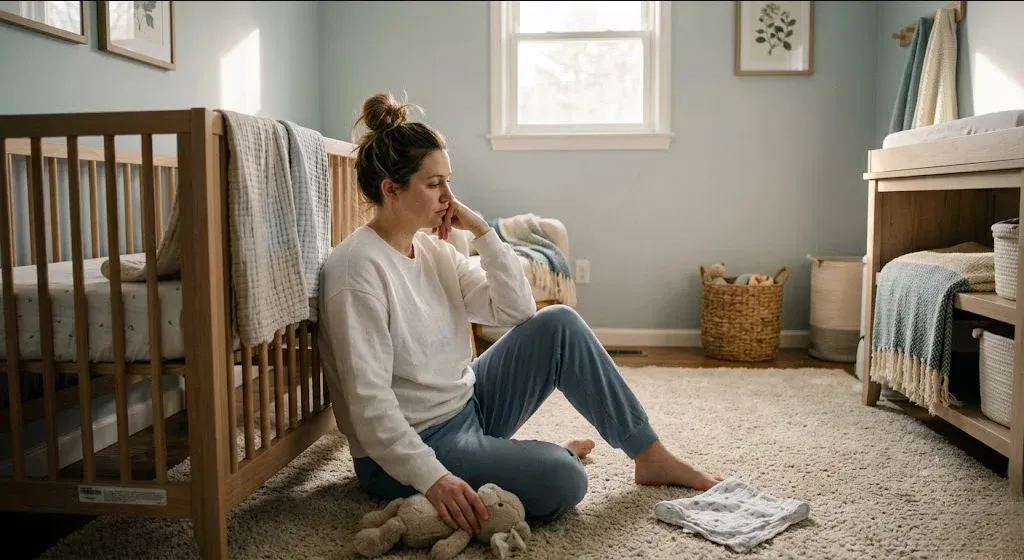
The baby is asleep on your chest. Your partner is in the next room. Your mother texts to check in. And you still feel completely alone. Not lonely in a way you can explain to anyone around you. In a specific, unplaceable way, like you're watching your own life from behind glass. That's postpartum loneliness. And it's more common than almost anyone tells you before you have a baby.
Surveys find that around 82% of new parents experience loneliness after having a baby, with nearly a third saying they feel lonely always or often. That's not a coincidence and it's not a personality problem. It's what happens when the whole architecture of adult social connection collapses at roughly the same time: career paused, daily routines erased, peer networks contracted, and the community support that was supposed to show up often absent. You're not failing to connect. The structures that used to make connection automatic are simply gone.
Why Postpartum Loneliness Is So Common
Most new parents in the United States raise infants in nuclear households, without the daily presence of extended family or a community of peers in the same life stage. Half of U.S. grandparents live more than an hour from their closest grandchild. Paid family leave, when it exists at all, typically ends within weeks. The informal daily social fabric of work, commutes, and shared routines disappears overnight. What replaces it is the constant physical presence of an infant and very little else.
Friendships with people who don't have children tend to fade in this period, not through conflict but through diverging circumstances. Socializing with a newborn is logistically hard. The emotional gap between your current life and your friends' lives grows quickly. Social networks naturally begin to contract in a person's late twenties and early thirties, and having a first child accelerates that contraction sharply.
There's also the identity piece. Becoming a parent involves a real psychological transition, not just an adjustment. Developmental psychologists and clinicians call this matrescence: the transformation of identity that parenthood requires. You lose a version of yourself that you spent decades building, your professional identity, your sense of autonomy, your social role. That loss produces a kind of isolation that has nothing to do with other people. It's about no longer fully recognizing yourself.
This Is Different From Your Relationship
One of the most disorienting things about postpartum loneliness is that it can exist alongside a loving, highly supportive relationship. Surveys find that roughly half of lonely new parents describe their families as highly supportive. The isolation is real. The love is real. Both can be true at the same time.
The mechanism helps clarify why. The loneliness that arrives with a baby is mainly about what's happened to your external world, not what's happening between you and your partner. Your career is paused or gone. The daily routines that structured your time have disappeared. The peer network you relied on, coworkers, friends who share your reference points, the ordinary social fabric of daily life, has largely contracted. A partner, no matter how present and loving, can't replace all of that. External structures provide something a single relationship can't fully substitute for.
This distinction matters because misreading postpartum loneliness as a relationship problem points toward the wrong fix. Partners sometimes end up in conflict, each interpreting the isolation as something the other person is causing. If you're feeling cut off in a relationship that is otherwise solid, that's not a signal the relationship is broken. It's information about what's been lost and what needs to be rebuilt.
When Loneliness Tips Into Depression
Postpartum loneliness and postpartum depression overlap in ways that matter clinically. Loneliness is a documented risk factor for developing postpartum depression, not just a symptom of it. Prolonged social isolation activates the same stress-response systems that drive depression: cortisol rises, sleep deteriorates, anxiety escalates. The longer isolation persists without structural change, the more likely the emotional experience is to deepen into something clinical.
The markers that warrant clinical attention include persistent sadness that doesn't lift, loss of interest in things that used to matter, difficulty bonding with your baby, or thoughts of harming yourself. These warrant evaluation by a provider, not just a change in self-care approach. The Edinburgh Postnatal Depression Scale is the standard screening tool providers use, and a score of 10 or above typically prompts a referral for further evaluation. You don't have to be certain whether what you're experiencing qualifies before reaching out.
If you're having thoughts of harming yourself or your baby, please call or text 988 (the Suicide and Crisis Lifeline). They provide specific support for perinatal mental health crises.
A useful frame: if what you're experiencing is mainly about missing external connection, your career, your friends, your previous sense of self, and it eases at least somewhat when you're genuinely connected with people, that's closer to loneliness than depression. If the flatness persists regardless of what's happening around you, or it's worsening over weeks, that warrants a conversation with a provider. You don't have to sort this out yourself before reaching out.
What Actually Helps
The unhelpful advice is 'get out more.' The reason it doesn't work is that it treats postpartum loneliness as a motivation problem when it's actually a structural one. You're not isolated because you haven't tried hard enough. You're isolated because the structures that used to make connection automatic have been removed. Rebuilding connection means building new structures, not simply trying harder.
Structured peer support groups designed specifically for new parents are the most consistent evidence-based response to postpartum isolation. Postpartum Support International (postpartum.net) offers more than 50 free virtual support groups, with specialized groups for new mothers, fathers, single parents, and families with NICU experiences. Groups are capped at small numbers, follow a structured format, and are designed to build genuine connection rather than just discuss problems. Their national helpline (1-833-TLC-MAMA) also offers free, confidential support 24 hours a day.
The identity piece has a useful frame too. The psychological shift of matrescence, treated as a real developmental transition rather than just an adjustment period, gives many parents language for what they're going through. The old identity doesn't fit the new life. That's not a problem to fix by trying harder. It's a process with a known shape, and a perinatal therapist is trained to help people move through it.
The type of connection that helps most is specific. Being around people who genuinely understand your current situation, parents with young babies, people who don't need context to understand why you're exhausted or why you had to cancel, tends to produce actual relief rather than just social contact. Structured groups are more reliable than unmoderated social feeds, which can tip toward comparison and anxiety rather than support.
If Your Partner Is Struggling Too
Paternal postpartum loneliness is common and chronically underreported. About 62% of new fathers experience loneliness after a baby arrives. The mechanism is different from maternal isolation: professional pressure often intensifies at exactly the moment access to emotional outlets decreases. Many fathers fall into a 'supporting the supporter' pattern, prioritizing the mother's recovery while their own mental health needs go unaddressed. Around 10% of new fathers develop postpartum depression, yet help-seeking rates remain low because most existing conversations about postpartum mental health center on mothers.
Both parents can be genuinely isolated at the same time. Each is absorbed in their own adjustment. The physical and emotional demands of the fourth trimester place enormous pressure on the household in both directions, and neither person typically has the bandwidth to fully close the gap for the other.
Naming this out loud, between partners, tends to help more than either person trying to hold it together. It's not a competition for who's more isolated or who needs more support. When both people are struggling, external support, whether peer groups, therapy, or both, provides something neither person can provide for the other. Reaching out isn't a sign the relationship has failed. It's what people do when they're dealing with something genuinely hard.
Postpartum loneliness doesn't require waiting until things become a crisis before getting support. A perinatal therapist understands the identity loss, the friendship contraction, and the way isolation can deepen over time. That's different from general therapy, and it matters. Most Phoenix Health therapists hold PMH-C certification from Postpartum Support International, the clinical credential for perinatal mental health. If you're ready to talk to someone, our postpartum depression therapy page connects you with providers who already understand what you're dealing with. You don't have to explain why the baby is wonderful and you still feel completely alone.
Frequently Asked Questions
- Very much so. Around 82% of new parents report experiencing loneliness after having a baby, with nearly a third saying they feel lonely always or often. Rates are higher among new parents than in the general adult population. What makes it so common is structural: having a baby tends to remove the key conditions for adult connection at exactly the moment new demands are highest. Your career is paused, routines are gone, peer networks have contracted, and the extended family support most parents expected often doesn't materialize the way they imagined. Postpartum loneliness is not a sign that something is wrong with you or your relationships. It's what the data says to expect, and it's something that can get better.
- Postpartum loneliness is an emotional response to social isolation and identity disruption. Postpartum depression is a clinical mood disorder. They can overlap, and loneliness is actually a risk factor for postpartum depression, not just a symptom of it. The distinction that matters most clinically: if what you're experiencing is mainly about missing external connection and it eases at least somewhat when you're genuinely connected with others, that's closer to loneliness. If you have persistent sadness that doesn't lift, loss of interest in things that used to matter, difficulty bonding with your baby, or thoughts of harming yourself, those warrant clinical evaluation rather than self-management. You don't have to be certain which is which before reaching out to a provider.
- It depends heavily on what changes structurally. For some parents, it eases in the first few months as new routines form and it becomes easier to socialize. For others it persists longer, particularly when the underlying structural causes aren't addressed. Social isolation, identity loss, and friendship contraction don't resolve on their own without active effort. Parents who rebuild connection through structured peer groups, a return to meaningful activity, or therapy with a perinatal specialist tend to recover faster than those who wait it out. There's no fixed timeline, but the complete isolation of the earliest weeks is not typically permanent, and earlier support produces faster improvement than waiting.
- Structured peer connection tends to work better than generic socializing. Postpartum Support International hosts free virtual support groups for new mothers, fathers, and families in specific situations, and the format is designed to build real connection rather than just discuss problems. Beyond peer support, therapy with a perinatal specialist can help with the identity piece, the mourning of your pre-baby self and the developmental process of building a new one. The matrescence framework, which treats the transition into parenthood as a real developmental stage, gives many parents a useful way to understand what they're experiencing. Reaching out to a provider earlier rather than later typically produces faster improvement.
- Yes, it can. Sustained social isolation and the distress it produces can make it harder to be emotionally present in the way bonding requires. Loneliness is associated with elevated cortisol and disrupted sleep, both of which affect emotional regulation and responsiveness. This doesn't mean loneliness causes permanent bonding problems or that you're a bad parent. It means that the conditions which support bonding, emotional regulation, some sense of self, adequate rest, are the same conditions that reduce isolation. Addressing the loneliness directly, rather than simply trying harder at bonding, is often the more effective path. A perinatal therapist can help with both.
Ready to get support for Postpartum Depression?
Our PMH-C certified therapists specialize in Postpartum Depression and can typically see you within a week.
Not ready to book? Dr. Emily writes a short email series on Postpartum Depression, honest and practical, from a PMH-C therapist who's been through it herself.
No spam · Unsubscribe anytime